Why "Best" Is the Wrong First Question
Search for the best open source large language model and you will get a ranked list. The list will be out of date within weeks, and it will tell you almost nothing about the decision you are actually making.
A model is not just a set of numbers on a benchmark. It is an artifact produced by a specific organization, paid for by specific investors, released under specific terms, and distributed through a small number of hubs and cloud catalogs. Those facts change more slowly than rankings — and they are the ones that determine whether you can ship a product on the model, whether you can keep running it in three years, and who can stop you.
This piece is a map of that second layer: how the ecosystem is structured, where the dependencies sit, and what questions a team should ask before adopting anything.
What readers actually see
Model names and rankings. Llama, Mistral, Qwen, DeepSeek, Gemma, Phi, Kimi, OLMo. Leaderboard positions that shuffle with each release cycle. Announcement posts describing a model as "open."
What they don't see
Who paid for the training run. Whether the terms attached to the weights are a standard open source license or a bespoke one with conditions. Whether the weights are practically obtainable outside one or two hosting platforms. Whether the organization maintaining the model will still exist, in its current form, at the end of your product roadmap.
How this analysis maps the ecosystem
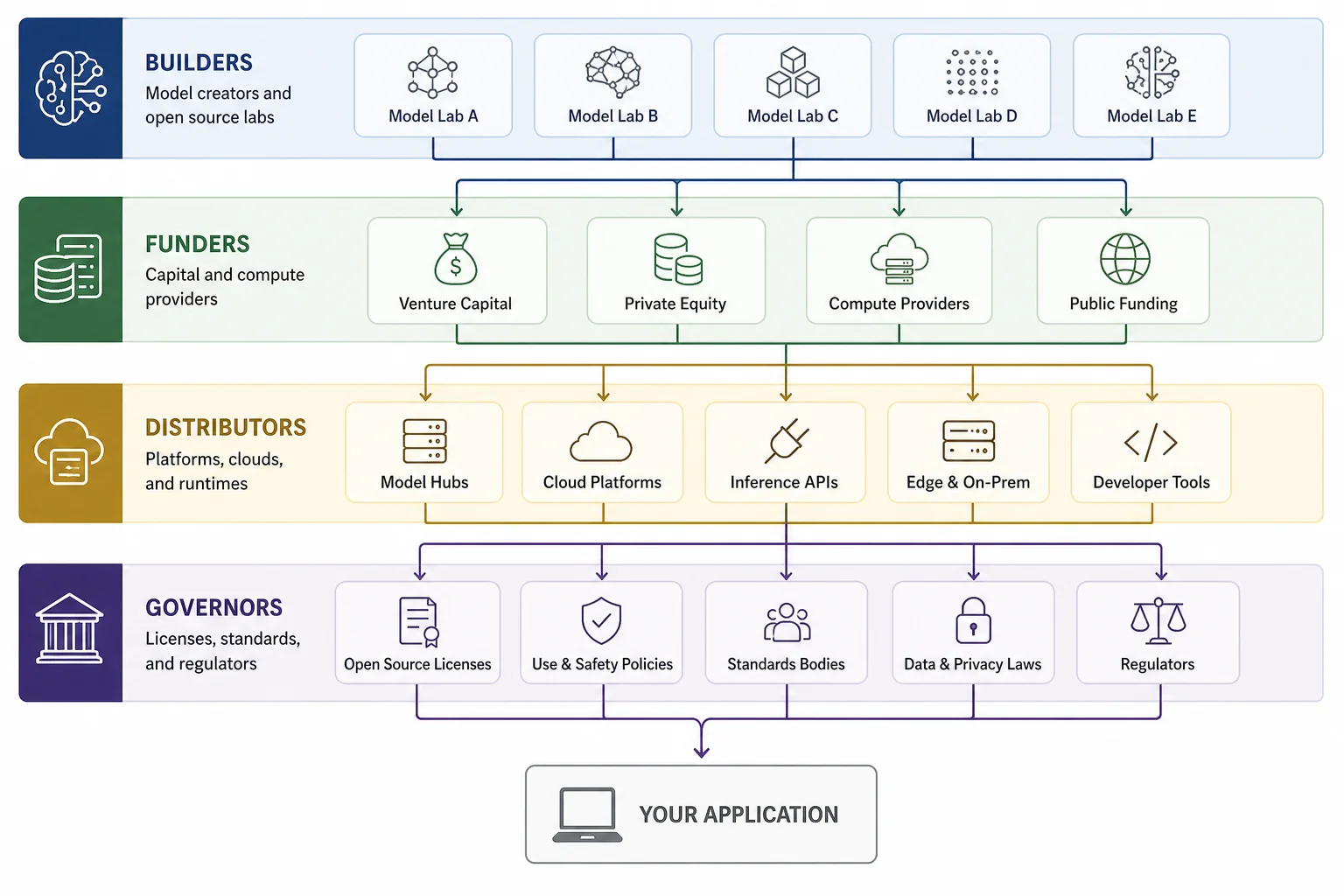
Four layers: builders who release weights, funders who supply capital and compute, distributors who control the path from file to inference, and governors — licenses, regulators and platform operators — who can restrict access after the fact. Performance is one variable among these, not the headline.
How to read this article, and what it does not do
A note on method, stated once so the rest of the piece does not have to repeat it.
This is a structural analysis of the open-weight ecosystem, not a verified snapshot of it. Model families are named here because they recur in public discussion of openly released models, not because a download, adoption or benchmark ranking has been measured for this article. No exact model version, license type, funding round, investor, valuation, compute agreement or cloud catalog listing is asserted, because each of those requires a primary-source check — the developer's own model card and license file, the provider's own catalog documentation, the company's own funding announcement, the regulator's own published text — at the moment you rely on it.
That is a real limitation, and it is worth being blunt about it: the model-by-model comparison table this subject deserves cannot be written from general knowledge. It has to be built by opening each official model card and license file and recording what they say, with the date of access. The sections below tell you which fields that table needs and why each one matters, so that the verification work is targeted rather than open-ended.
Everything structural in this article — how license categories differ, where distribution concentrates, what changes when a model is withdrawn — holds regardless of which specific release you are evaluating. Everything specific is yours to confirm.
What "Open Source" Actually Means for LLMs
The vocabulary is doing a lot of work in this market, and it is frequently doing it badly.
Open weights vs. open source vs. open data
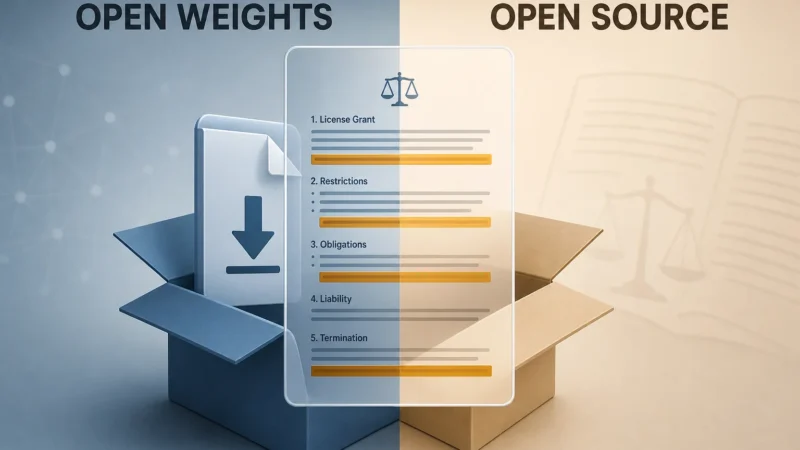
Open weights describes availability: the trained model parameters can be obtained, typically as downloadable files. Availability is not permission. What you may then do with those parameters — run them, fine-tune them, redistribute them, build a commercial product on them, publish a derivative — is determined entirely by the license and any policies incorporated into it, not by the fact that the file downloaded successfully. Two models can both be "open weights" and grant materially different rights.
Open source, as the term is conventionally used in software, implies a defined set of freedoms: to use, study, modify and redistribute without discriminatory restrictions. Applying that standard to a model raises questions software licensing never had to answer, because a model's behavior is a product of training data and training code as much as of the released weights.
Open data — publication of the training corpus, or a detailed accounting of it — is the rarest of the three. Many openly released models ship weights and a model card describing intended use and limitations without releasing the full training set. Whether a particular release includes data documentation is a fact to read off its model card.
So "open weights" is the more accurate default description for much of this market, and it says nothing on its own about rights. Treating every openly released model as interchangeably "open source" obscures differences that matter commercially.
Standard licenses vs. custom model licenses
Two broad patterns exist.
The first is release under a standard, well-understood open source license such as the Apache License 2.0 or the MIT License. These are familiar to legal teams, have decades of interpretive history in software, and impose few conditions beyond attribution and, in Apache 2.0's case, notice and patent provisions. A caution that applies to both: these licenses were drafted for software, and how they operate over model weights — an artifact whose legal status as a copyrightable work is itself debated in some jurisdictions — is less settled than their long software history suggests. That is a question for counsel, not a settled matter this article can resolve.
The second is a custom model license written by the releasing lab. These vary. Some closely resemble permissive software licenses; others attach conditions such as acceptable-use restrictions, naming or attribution requirements, or thresholds above which separate terms apply. Which conditions apply to which model is not something to generalize about — it is something to read.
The practical rule: read the actual license file distributed with the weights, not the launch blog post, and note the date you read it. Where a model family's terms matter to your business, have that specific text reviewed by qualified counsel rather than relying on secondhand summaries, including this one.
The Open Source Initiative's position
The Open Source Initiative (OSI), the body that maintains the Open Source Definition for software, has been the focal point for the argument about what "open source AI" should mean and has published an Open Source AI Definition addressing which components of an AI system must be available for the label to apply. Readers evaluating a specific model against that standard should consult the OSI's published definition text directly. This article does not paraphrase its criteria, and no model is described here as meeting or failing it — that determination requires reading the definition against the model's actual release artifacts.
Why the label matters
Because procurement, redistribution and derivative works all hinge on it. A permissively licensed model can generally be embedded, modified and redistributed under well-mapped conditions. A custom-licensed model may allow the same activities in practice while reserving rights that only surface when you scale, when you build a competing product, or when your use case falls inside an acceptable-use carve-out.
The Builders: Who Releases the Leading Models
The developer layer is more varied than the leaderboards suggest. The organizations below are included because they recur in public discussion of openly released models; the grouping is descriptive, and no ranking or download-share claim is made about any of them.
The fields a model profile needs
Before the categories, here is the profile every model family in your evaluation should have. Each field is filled from a primary source, with the date you read it:
| Field | Where it comes from |
|---|---|
| Exact release name and version | Developer's official model card or repository |
| Developer and legal entity | Developer's own materials |
| License type and full text | License file distributed with the weights |
| Acceptable-use policy or incorporated policies | Linked from the license or model card |
| Training data disclosure | Model card |
| Official weights location | Developer's repository or hub page |
| Managed cloud availability | The cloud provider's own catalog documentation |
| Disclosed funders or compute partners | Company announcement or reputable financial reporting |
| Release cadence and support posture | Developer's release history and stated policy |
A table filled in that way is the power map for your specific decision. The categories below explain what each type of builder tends to imply for those fields.
Big Tech research arms
Several of the largest technology companies release open-weight models alongside closed flagship products. Meta AI publishes the Llama family; Google DeepMind publishes Gemma; Microsoft publishes the Phi family of smaller models. Release terms differ across these families and across generations within them, so the license file, not the corporate parent, is the thing to check.
On motive, the honest position is that these companies state their own reasons in their announcements, and that outside observers commonly read open-weight releases as ecosystem strategy — building developer familiarity and seeding tooling around a capability layer while the most capable systems remain proprietary. That reading is analysis, and it is not a statement any of these companies has made in those terms.
For adopters, the practical implication of a large corporate parent is a comparatively predictable maintenance base and a license that legal teams may already have reviewed for an earlier generation — neither of which guarantees that the next generation carries the same terms.
Independent and venture-backed labs
Mistral AI, based in France, is among the most frequently cited European independents releasing open-weight models alongside commercial offerings. Labs in this category face a structural tension: they must give away enough to matter and retain enough to build a business. Release terms in this tier are worth re-reading with every generation, because release policy is also revenue policy.
China-based labs
Chinese labs are a significant presence in the open-weight ecosystem. Alibaba's Qwen family, DeepSeek and Moonshot AI's Kimi models are among the most discussed internationally.
Two cautions. First, a lab's hosted consumer or API product and its openly released weights are different things with different terms; do not infer the license of one from the availability of the other. Second, model naming in this tier moves quickly and internal coverage is not a substitute for the developer's own materials — verify the exact release name against Moonshot AI's, Alibaba's or DeepSeek's official announcements before you cite it. NewsForge's coverage of Moonshot AI's international reception is in Kimi K3: Threat or Menace? Unpacking Moonshot AI's Global Impact, and Alibaba's move into consumer distribution channels is covered in Apple Intelligence Approved for Launch in China with Alibaba's Qwen AI.
For adopters outside China, the decisive questions are usually not about model quality. They are about license terms, data handling if a hosted endpoint is used, and whether the developer's jurisdiction creates procurement or policy friction inside your own organization.
Nonprofit, academic and community-led releases
AI2 (the Allen Institute for AI) publishes the OLMo family with a stated emphasis on openness across the training pipeline rather than weights alone. EleutherAI is a long-running community research collective with a history of open model and dataset work. These groups are small relative to the corporate labs but matter disproportionately to the definitional argument, because they demonstrate what a more complete form of openness can look like in practice. What any given release actually documents is, again, on its model card.
The Funders: Where the Money and Compute Come From
Nothing about a large training run is free. When weights are given away, the cost has been paid somewhere upstream. This section describes the shapes those arrangements take and what to look for; it does not state amounts, investor names, valuations or deal terms for any named lab, because those require a primary announcement or established financial reporting and are not asserted here on general knowledge.
What to look for in a funding chain
When you research a lab's backers — and for a single-product startup you should — separate four things that press coverage often blurs:
- Equity investment. Cash for ownership, from conventional funds or strategic corporate investors.
- Compute commitments and credits. Access to accelerators or cloud capacity, sometimes as part of an investment package.
- Commercial distribution arrangements. Preferred placement in a cloud catalog or a bundled product.
- Hardware access. Priority allocation of accelerators, which is a distinct commodity from cash.
Each has a different failure mode. Equity dilutes; compute commitments expire; distribution deals can be non-exclusive or exclusive; hardware allocations can be reprioritized.
Cloud providers as investors and suppliers
A recurring pattern in AI financing is that the same organization can appear as both investor and supplier — capital invested by a cloud provider may be spent, in part, on that provider's own compute. Where such an arrangement exists it is generally disclosed by the parties, and its terms should be read from their announcements rather than assumed. The point for adopters is narrower and more durable than any single deal: "independent lab" and "independent of any hyperscaler" are different claims, and only the parties' disclosures tell you which one applies.
Chip supply as an upstream constraint
Accelerator availability is an upstream constraint on who can train large models at all. NVIDIA is the most widely referenced supplier of AI training accelerators, and alternatives exist, including cloud providers' in-house silicon and other merchant vendors; any statement about market share belongs with a dated source rather than in general prose. The structural point stands without the number: a lab's ability to release competitive open weights depends in part on its access to training hardware, and that access is itself shaped by export policy, discussed below.
Sovereign and public-sector funding
Governments have increasingly framed domestic model capability as strategic infrastructure, and several have announced national compute and AI funding programs. Program scale, eligibility and conditions differ substantially by country and should be verified against the relevant government's own publications before being relied on.
The Distributors: Hubs, Clouds and Inference Providers
A weight file that nobody can conveniently obtain or serve is not, functionally, available. Distribution is where a great deal of practical power sits.
Model hubs
Hugging Face is the most widely used public repository for openly released models, hosting weights, model cards and associated datasets. Concentration of discovery, download and versioning on a small number of platforms is convenient and is also a dependency. Whether a specific model is present on a specific hub, and under which terms, should be confirmed on the hub page itself, with the date noted.
Managed cloud catalogs
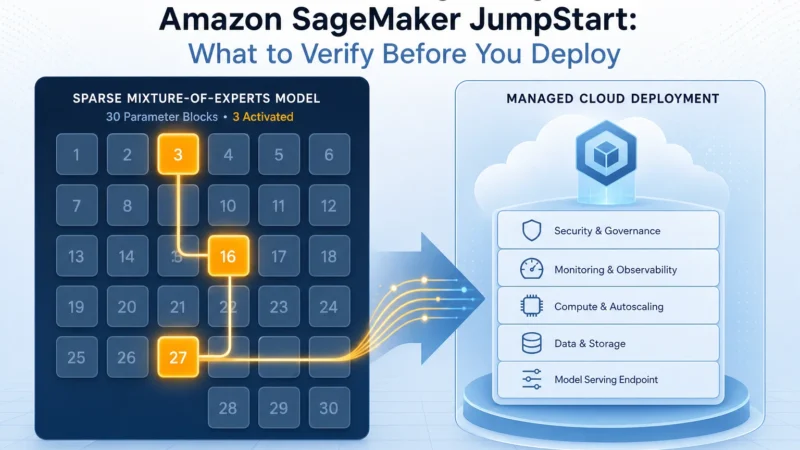
The major clouds run curated model catalogs — Amazon Bedrock, Microsoft Azure AI Foundry and Google Cloud Vertex AI among them — that offer selected models as managed endpoints. Consuming an open-weight model this way, rather than by downloading and self-hosting, is an operationally reasonable choice, but it reintroduces much of the dependency that open weights were supposed to relieve: the endpoint, its pricing and its continued availability are the provider's decisions.
Catalog contents change. Which models a given catalog carries, in which regions, is a fact to read from the provider's own catalog documentation on the day you need it — and to record with that date, because procurement questions six months later will turn on what was true when you decided.
Third-party inference providers
A layer of specialist inference companies serves open-weight models via API, competing on price, latency and hardware. They widen choice at the serving layer while adding another vendor relationship, another data-handling posture and another point of failure.
Local and self-hosted runtimes
The decentralizing tier is the runtime layer, and its components are not interchangeable:
- llama.cpp is an efficient C/C++ inference implementation widely used for running quantized models on consumer hardware, including laptops and CPU-only machines.
- Ollama packages local model download and serving behind a simple command-line and API interface, aimed at running models on a personal or single-server machine.
- vLLM is a serving library aimed at high-throughput inference, typically on GPU servers rather than laptops.
Consult each project's own documentation for supported models, hardware requirements and license before assuming it fits your deployment. The structural significance of this tier is straightforward: if you hold the weights, have the rights to use them, and can serve them yourself, no single distributor's decision is fatal to you.
The Governors: Licenses, Policy and Takedown Power
Release is not the end of control.
Acceptable-use conditions
Some model licenses incorporate an acceptable use policy prohibiting categories of application, and some attach further conditions tied to scale or use type. Whether such a policy exists for a given model, what it prohibits, and whether the developer can revise it unilaterally after your download are all things to read in the specific documents.
On enforceability, this article takes no position. Whether a given acceptable-use term binds a particular user depends on assent, the license's own wording, incorporation of external policies and the governing jurisdiction — a question for a licensing attorney reviewing the actual text, not a general rule. Treat these clauses as commercially significant and legally fact-specific.
Export controls
US export controls on advanced AI chips are administered by the Commerce Department's Bureau of Industry and Security (BIS) and restrict the export of certain high-end accelerators to specified destinations. The rules are technical, have been revised repeatedly, and the operative version — covered products, destinations, license requirements and effective dates — must be read in BIS's own published rule text and implementation notices as they stand when you check. This article does not summarize their scope.
Their principal effect on this map is indirect: by shaping who can obtain training hardware, chip policy influences who is positioned to train and release competitive models. That causal link is analysis rather than a finding of the rules themselves.
The EU AI Act
The EU AI Act establishes obligations for general-purpose AI models, and its provisions treat models released under free and open-source terms differently from closed ones in certain respects, subject to conditions. Which obligations apply, to which actors, from which dates, and what the open-source-related provisions require are set out in the Act's own text and official EU guidance.
Two points that headline coverage often flattens: the differential treatment is not a blanket exemption, and it does not apply uniformly across all obligations — models meeting certain thresholds remain subject to requirements regardless. Organizations placing models on the EU market should work from the Act text and Commission guidance directly, with the applicable dates confirmed, rather than from summaries including this one.
When a model is pulled or relicensed
This is the question adopters most often overlook, and it has two halves that should not be confused.
Withdrawal of distribution is the common case: a hub page is removed, a hosted endpoint is retired, a download link stops working, or a new generation ships under different terms. In that scenario the new terms generally govern the new release, and support and security updates for the old one may stop.
Termination or revocation of rights you already hold is a different question, and the answer depends on the license's own wording — whether the grant is stated as irrevocable, whether it is conditioned on continued compliance, whether external policies are incorporated by reference and can be revised — and on the governing jurisdiction. It is not safe to assume that a downloaded file carries perpetual rights. Where the consequences are material, put the specific license text in front of qualified counsel.
The practical mitigations are the same either way, and they are evidentiary and operational rather than dispositive: retain a copy of the weights where the license permits it, retain a dated copy of the license text and any incorporated policies as they stood when you accepted them, and maintain the capability to self-host.
Five Dependencies to Check Before You Adopt a Model
One decision question each. Detail underneath.
1. License — may we actually do this?
Read the license file distributed with the weights, not the announcement. Is it a standard open source license or a custom one? What does any acceptable-use policy prohibit, and can it change? Are there conditions that trigger at scale? Save a dated copy of everything you relied on.
2. Provenance — is this file what it claims to be?
Where did you obtain it, and does the developer's official model card match? Note stated training data, intended use and known limitations. Absent disclosure is not automatically disqualifying; undocumented absence is.
3. Concentration — what breaks if one provider says no?
List every step between weights and users: hub, cloud catalog, inference API, runtime. For each, ask what happens if it becomes unavailable or is repriced. If the honest answer is "we stop," you have an API dependency, whatever the model is called.
4. Maintainer — who ships the next version?
Identify the maintaining organization, its funding posture and its release history. A single-product startup is a different risk profile from a large research arm or a nonprofit institute. Different, not necessarily worse — but it belongs in the decision record.
5. Integrity and application security — two checks, not one.
Artifact integrity: prefer serialization formats that do not permit arbitrary code execution on load, verify official hashes or signatures where the publisher provides them, pin exact revisions, review loader and framework dependencies, and load untrusted artifacts in a sandbox.
Application layer: prompt injection, data exfiltration and tool-use abuse are risks in the system around the model, not properties of the file, and need their own controls. NewsForge's broader coverage of AI's effect on defensive practice is in Will Cybersecurity Be Replaced by AI? Risks, Defenses, and What Changes Next.
Record each item as pass, risk accepted or blocker, with a named owner and the date checked. That record, not the benchmark score, is what a procurement or security review will ask for.
Frequently Asked Questions
What is the difference between an open source LLM and an open weights LLM?
"Open weights" describes availability: the trained parameters can be obtained. "Open source" describes rights: freedom to use, study, modify and redistribute without discriminatory restrictions, as the term is conventionally understood in software. A model can be open weights without being open source. The Open Source Initiative has published an Open Source AI Definition setting out which components must be available for the label to apply; check a specific model against that text rather than against its marketing.
Can a company legally use an open weights model in a commercial product?
It depends entirely on the license attached to that specific release and on any policies incorporated into it. Some models ship under standard permissive licenses; others use custom terms with conditions on use, scale or application type. Applying software licenses to model weights also raises questions that are less settled than their software history implies. Read the license file, note the date, and have counsel review it where the commercial stakes are material.
What happens if a lab changes a model's license or removes the weights after release?
Distinguish two things. Withdrawing distribution — removing a hub page, retiring a hosted endpoint, shipping the next generation under new terms — is common and mostly affects future access and support. Whether rights you already hold can be terminated depends on the license's own wording and the governing jurisdiction, and should not be assumed either way. Practical mitigations: retain the weights where permitted, retain dated copies of the terms, and keep the ability to self-host.
Which cloud platforms and model hubs control distribution of open models?
In practice, discovery and download concentrate on a small number of public hubs, with Hugging Face the most widely used, while enterprise consumption often runs through managed catalogs such as Amazon Bedrock, Microsoft Azure AI Foundry and Google Cloud Vertex AI. Which specific models each carries, in which regions, changes; confirm it in the provider's own catalog documentation and record the date.
Does open weights availability actually reduce vendor lock-in?
Partly, and conditionally. Open weights offer an exit that a closed API does not: in principle you can take the file elsewhere. The exit is only real if you hold the weights, have the license rights to use them, and have the serving capability and operational skill to do so. Teams that consume open models exclusively through one managed endpoint have bought the optionality without exercising it.
What are the real risks of building on a model maintained by a single startup?
Concentration of maintenance, funding and release policy in one organization. If the roadmap changes, funding tightens or ownership changes, the next version, the support posture and the license terms can all move together. The mitigations are the ones in the checklist: retained weights, dated terms, self-hosting capability, and a documented fallback model.
What to Watch Next
Four signals, offered as analysis rather than prediction, each with something concrete to monitor.
Consolidation pressure on independent labs. Training costs are high and differentiation at the open-weight tier is hard to sustain. Indicator: lengthening gaps between releases, ownership or partnership announcements, and open-weight releases quietly giving way to hosted-only products.
License drift. Indicator: diff each new release's license file against the previous generation's. Added conditions, new incorporated policies, or a move from a standard license to a custom one are the changes that matter — more than any launch-post language about openness.
Regional ecosystems and sovereign AI. National and regional programs promoting domestically developed models continue to be announced. Indicator: whether procurement rules in a jurisdiction begin to specify model origin, and whether catalogs fragment by region.
What a genuine shift in control would look like. Not a new leaderboard leader. Indicators: a major lab moving from custom terms to a standard open source license, or the reverse; a serious challenger to hub concentration; a widely adopted model shipping with full training-data documentation; or accelerator supply broadening enough that large-scale training is no longer gated by one hardware pipeline. Those changes would move the power map. Ranking churn does not.
Before your next model decision, run the five dependencies — license, provenance, concentration, maintainer, integrity — and verify each against a primary source, with the date recorded. Licenses, funding and hosting arrangements shift faster than benchmarks do. Follow NewsForge's AI coverage to keep the map current as they do.
This analysis describes the structure of the open-weight model ecosystem. It does not constitute legal advice; license and regulatory questions with commercial consequences should be reviewed by qualified counsel against the primary texts.