A sparse agent model is now a catalog item
The story here is distribution, not architecture. A sparse model that AWS describes as open and purpose-built for continuous agent traffic is now a listing teams can deploy from a console they already use — which moves the open-model conversation away from "can I obtain the weights?" and toward "what does it cost to keep an agent running around the clock?"
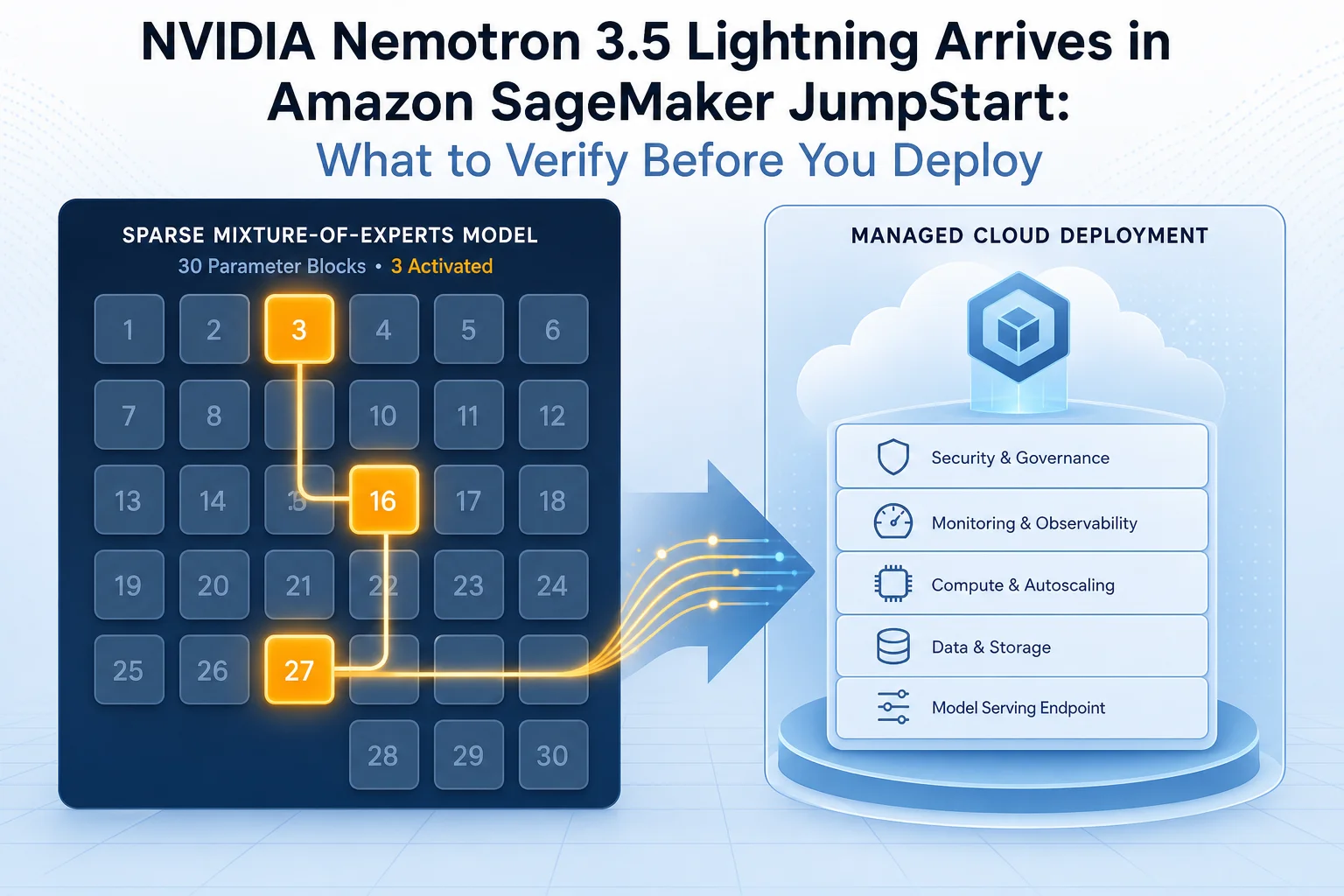
The reported core: the AWS Machine Learning Blog has published a post titled "NVIDIA Nemotron 3.5 Lightning now available in Amazon SageMaker JumpStart." NVIDIA Nemotron 3.5 Lightning, described by AWS as an open model built for high-volume agentic workloads, can now be deployed through Amazon SageMaker JumpStart, the model catalog inside Amazon SageMaker. According to that post, the model is a 30-billion-parameter Mixture-of-Experts (MoE) architecture with 3 billion active parameters, and it delivers up to 4x higher throughput and up to 30% faster task completion for always-on agents. The post is framed as a walkthrough of how to deploy the model from JumpStart.
One caveat governs everything that follows, and it is stated here once at full strength: the performance figures are vendor figures, published by AWS about a model built by NVIDIA. The material available to us does not disclose the comparison baseline, the hardware, the workload profile, or the measurement method behind them, and NewsForge has not independently tested them. They are claims to verify, not planning inputs.
If you run continuous agents, do this
Do not start by accepting or rejecting the 4x figure. Instrument your own system first — calls per task, input and output token lengths, concurrency, endpoint utilization. Then benchmark this model on your highest-frequency step, the routing or extraction or tool-selection call you make thousands of times a day, against whatever you run today at your own quality threshold. That measurement is the only version of the throughput claim that will pay your bill.
What "30B Mixture-of-Experts with 3B active" actually means
The two numbers describe different resource demands: a model can use fewer parameters per token while still requiring a substantial hardware footprint, and that gap is the point of the architecture. Active parameters are a proxy for compute per token, the lever that moves throughput and latency. Total parameters are a major driver of weight storage and therefore of hardware footprint, though precision, quantization, sharding, context length, and concurrency also matter.
A dense language model applies essentially all of its parameters to every token it processes. A Mixture-of-Experts model instead splits much of the network into parallel subnetworks — "experts" — with a routing component selecting a small subset for each token. The model still stores all of its parameters; it uses only a fraction of them on any given pass. AWS describes 3 billion active parameters out of 30 billion total.
Two operational implications follow. Runtime memory tracks the full weight set plus the key-value cache and activations, which grow with context length and concurrency — so reading only the active-parameter figure understates memory requirements. And serving performance has to be measured rather than derived: realized throughput depends on the serving stack, batch composition, and how evenly requests distribute across experts.
Sparse activation is an efficiency technique, not a quality guarantee. Architecture alone does not tell you how output quality compares with a dense model of any particular size, and the announcement does not address that question.
The performance claims — and how to read them
"Up to" is doing more work in these figures than either the 4 or the 30. It describes a ceiling observed under some condition, not an expected value. Without a disclosed baseline, the same phrasing would be true of a comparison against another Nemotron model, against a dense model of similar total size, or against the same model on slower serving software — three claims of very different commercial weight.
Two questions decide whether the numbers mean anything for you. Compared with what, on what hardware? Throughput moves sharply with GPU generation, memory bandwidth, and sharding, and the choice of baseline model can swing a ratio by more than the ratio itself. What counts as a "task"? A full multi-step agent run and a single inference call are not the same unit, and a 30% gain means something quite different in each.
Treat both performance numbers as vendor figures; benchmark them against your own workload.
Why "always-on agents" is the workload the announcement targets
The framing in the announcement — high-volume agentic workloads, always-on agents — is more informative than either number, because it tells you which cost model the design assumes.
If your system makes one model call per user message, cost per call is a reasonable way to think about spend. If one user-visible task expands into several calls — planning, tool calls, a re-planning step, a check, a summary — the useful figure becomes sustained throughput per unit of GPU time at your utilization level. For a provisioned, instance-based endpoint, spend is driven by the time the infrastructure remains running, not only by the tokens it produces; other SageMaker deployment options charge differently, so confirm which one applies to you. Per-token compute stops being a line item and becomes a multiplier applied to a very large token count.
Latency compounds in the same direction. If twelve steps run strictly one after another, a step that takes two seconds instead of three is the difference between roughly 24 seconds and 36 seconds of model time — before tool calls, network hops, and orchestration overhead, and assuming no steps run in parallel. That is the mechanism by which a per-call speedup becomes a "faster task completion" figure, though the announcement does not define what it counted as a task.
A smaller active-parameter model is most plausibly a fit for the high-frequency, low-reasoning steps that dominate token volume: routing, extracting structured fields, tool selection, summarizing a tool response. The steps that deserve the most careful evaluation are those where one call carries most of the reasoning burden — multi-hop planning, code that must be correct first time, anything where an error propagates silently. Whether this model is strong or weak at any of them is an empirical question the announcement does not answer.
Deploying from SageMaker JumpStart: what changes
The trade is control for time. A model a team might otherwise acquire and host itself is now listed as a deployable option inside a managed environment many organizations already operate in. Self-hosting means owning the whole chain — obtaining the weights, choosing and tuning a serving stack, sizing and sharding, building autoscaling and monitoring. A catalog deployment shifts part of that work into a managed flow. Because a throughput-sensitive agent workload is precisely the case where serving-layer tuning can matter, benchmarking both routes beats assuming they are equivalent.
Two operational items deserve attention either way. Instance choice is set by total parameter count and runtime memory, not by the active-parameter figure. And data governance — where inference runs, under which account and network configuration — is a question a managed endpoint answers differently from a self-managed cluster.
Deployment steps, supported AWS Regions, and instance requirements change; the AWS post and the JumpStart listing in the SageMaker console are the authoritative record.
What "open" does and does not tell you here
For teams already operating in SageMaker, the important change is distribution: catalog placement can make an openly available model deployable without a separate weight-acquisition and self-hosting workflow, lowering the operational barrier to evaluating a model a team might not otherwise host itself.
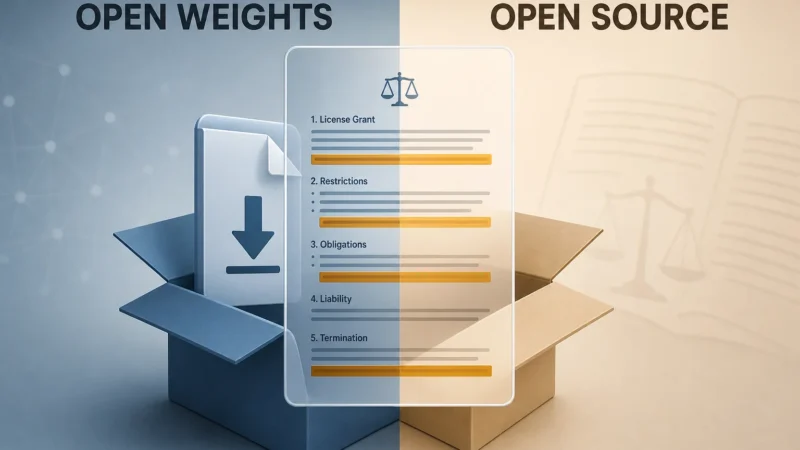
That convenience does not settle the model's legal status. AWS calls Nemotron 3.5 Lightning an open model, and the term is used loosely across the industry. An openly available model whose weights can be downloaded is not the same as a permissively licensed one, and neither is the same as open-source software. Commercial use, redistribution, and fine-tuning rights depend on the license text.
We make no head-to-head comparison with any other model, because no source we have supports one.
What to watch next
- Independent workload benchmarks. Third-party numbers on named hardware with disclosed batch sizes and token lengths — and agentic evaluations rather than single-turn ones.
- License, context window, and deployment constraints. Confirm these in the current NVIDIA model card, license, and JumpStart listing, including supported AWS Regions and instance types. Long agent transcripts reach context limits quickly, so this is not a formality.
- Your own numbers. Run the model on the step you call most often, at your quality threshold, and compare it with what you run today. Compare the stated throughput claims against your own agent traffic before committing anything to it.
Editor's note
The following could not be confirmed from a primary source at the time of writing and were omitted rather than approximated: the publication date of the AWS post; the comparison baseline, hardware, workload, and measurement methodology behind the "up to 4x higher throughput" and "up to 30% faster task completion" figures; the model's license terms and distribution conditions; its context window; supported AWS Regions, instance types, and deployment steps; and any pricing, including which SageMaker deployment and billing model applies to a JumpStart deployment. All performance figures are attributed to the AWS announcement and have not been independently verified by NewsForge. No third-party benchmark or competitor comparison is cited because none was confirmed at draft time.